

Archive for May, 2009
Best route from Hollywood/Burbank to LAX during LA rush hour
by administrator on May.19, 2009, under Business Travel, Vacation
Given our 6+ months of experience dealing with Los Angeles traffic on a weekly basis, we would like to share with you a key route to avoid rush hour traffic traveling from the Valley to Los Angeles International (LAX). There are plenty options that takes you from the San Fernando Valley (Burbank, Glendale, Hollywood, etc.) to LAX. The options are:
1. CA-134 West to the US-101 North to the I-405 South — This is the worst option because the US-101 to I-405 merge is the worst traffic junction in the US. The 405 South is a disaster from the hill to the I-10 connection (probably a top 5 worst traffic bottleneck in the US). Going through two of the top five worst traffic junctions is not a good idea.
2. US-101 South to I-110 South — US-101 South is generally bad when heading downtown. The merge from US-101 to I110 is located in the heart of downtown Los Angeles which is one of the worst connectors in the US.
3. I5 South to I-110 South to the I-105 — You will need to merge twice with downtown traffic. The first merge is the I-5 to the I-110. The second merge is the I-110 with US-101.
ALL the options listed has its major bottlenecks. We have figured a way to modify Option 3 and cut our commute time from the Valley to LAX by 30 minutes compared to the normal bumper to bumper route.
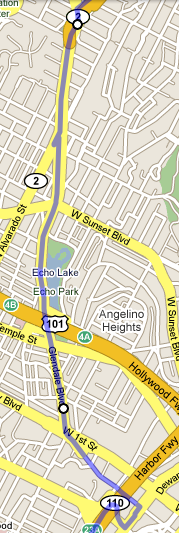
Here are the step by step directions:
1. Take Interstate 5 South which is normally clear until you get to Los Feliz Exit (Griffith Park). Right as traffic is building up, you will see CA-2 the Glendale Freeway.
2. Get on CA-2 (Glendale Freeway) South. CA-2 South ends in about a mile and turns into Glendale Blvd. Stay on your left when you hit Glendale Blvd (after the freeway ends). Go on Glendale Blvd for about 1.2 miles through local streets (passing Echo Park which is to your right) until Glendale Blvd ends.
3. When Glendale Blvd ends, you will see West 1st and West 2nd Street (see map). Make sure you bare left and go onto W2nd Street.
4. Stay on West 2nd Street until you have passed an underpass (which is I-110) and make a right at the light onto Figueroa Street.
5. Once you’re on Figueroa, make a right on the next light which is West 3rd Street.
6. On West 3rd Street, you will see the on-ramp for I-110 (Harbor Freeway) South.
7. Take I-110 Harbor Freeway South until you see I-105. There will be plenty of signs pointing you to LAX. The I-110 Harbor Freeway also has a bonus: the carpool lane.
8. Take I-105 West and exit Sepulveda which will take you straight to LAX, rental car return facilities and long term parking garages.
The above driving directions help you avoid the I-5 to I-110 merge as well as the I-110 and US-101 merge in downtown Los Angeles. These two junctions are one of the worst in America.
We hope you find these directions to be helpful. Feel free to leave us your comment or suggestions of better routes.
Things to do over a weekend in San Diego
by Captain G on May.18, 2009, under Business Travel, Vacation
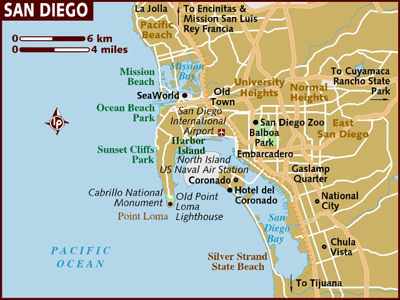
San Diego is the second largest city in California and one of my favorite destinations. The weather is great all year round in San Diego. If you are ever in the Greater Los Angeles area and have two days to spare, I highly recommend you take a drive down to San Diego. Below are my suggestions (with a map for reference):
Day 1
1. From LA, take the 405 South and pass Orange County. Exit La Jolla to check out downtown and the cove. La Jolla is a beautiful place to grab lunch before you continue your drive down to downtown San Diego. Go to one of the restaurants located along the cove (Prospect Street) for a great view while you dine.
2. After lunch, continue south on Interstate 5 and go past downtown. I recommend you make a stop at Coronado which is an island across the strait of downtown San Diego. Take exit 13B on Interstate 5 which is the San Diego-Coronado Bay Bridge. Once you are on Coronado island, go by Hotel Del Coronado which is on the southwest side of the island. Grab a drink at the hotel and walk along the shores where you can watch the sunset at Coronado.
3. After the sunset, you will be ready for some fine dining in the Gaslamp Quarter. Cross the San Diego-Coronado Bay Bridge and get back on Interstate 5 North. Get off on Market Street and head west. Instead of looking for meter parking around Gaslamp, I recommend you park at Horton Plaza where you can get 2 hours of free parking before 9PM. For Horton Plaza free parking, you will need to get your parking ticket stamped at a validation machine inside the mall. The downtown Gaslamp area has plenty of food options spanning from Sushi to Mexican to traditional American bars.
Day 2
1. To start Day 2, I recommend you start breakfast at the Seaport Village located by Harbor Drive and Kettner. Grab breakfast or brunch at one of Seaport Village’s restaurants. You can park in the lot as all restaurants and shops will validate your parking. After breakfast or brunch, take a stroll along the boardwalk for a view of the marina.
2. After breakfast/brunch, swing by Balboa Park for a mid-morning walk. There are museums, gardens, carousel inside Balboa Park. It is a very nice park to walk in. The San Diego Zoo is also inside Balboa Park.
3. While you are at Balboa Park, I highly recommend you go visit the San Diego Zoo. The San Diego Zoo is one of the largest zoos in the US and has tons of animals including pandas from China. I personally think the San Diego Zoo is the best zoo in the US.
4. Wrap up your day in Old Town after a day in the park and zoo. You can get to Old Town from the Zoo by taking I5 North to Exit 19. Old Town is a historic park with tons of Mexican restaurants and shops. You can have dinner at one of the restaurants or grab street food from vendors. There are also handcraft shops where you can buy a nice souvenir.
Day 3, 4, 5 (if you have the time)
If you have time to extend your stay in San Diego, consider the following attractions:
1. SeaWorld – great amusement aquarium.
2. Legoland – where you can recapture your youth or bring your kids 🙂
3. Wild Animal Park – the San Diego Zoo’s sister… this is where you can see animals live in the habitat.
Use your United airline miles to upgrade and beat point inflation
by Captain G on May.16, 2009, under Airlines, Business Travel, Vacation
Before booking an international ticket on United, I went through the Coach’s “Checklist for buying an international ticket.” In addition to the checklist, I went to UAL’s upgrade award chart and noticed UAL will be charging its customers a co-pay to use their airline miles to upgrade beginning July 1, 2009. Here’s the PDF and link for more details on how your miles are worth less and less in this economy. This is why I have been advocating to everyone to bank hotel points vs airline miles.
Under the new co-pay using miles to upgrade system, United will charge you $50 plus 15,000 for a one-way domestic (North America excluding Hawaii) upgrade unless you have a full fare economy ticket (which is class Y or B). The cost of the class Y or B ticket is nearly double. Your best bang for the buck on using miles to upgrade is for international tickets. The new co-pay system will have you paying $250 to $300 plus 25,000 miles each way for an international upgrade. Also keep in mind that the class of the international ticket must be class M or H or B — near full fare economy class.
The cost differential between a discounted economy ticket and a near full fare ticket is nearly double (see picture below):
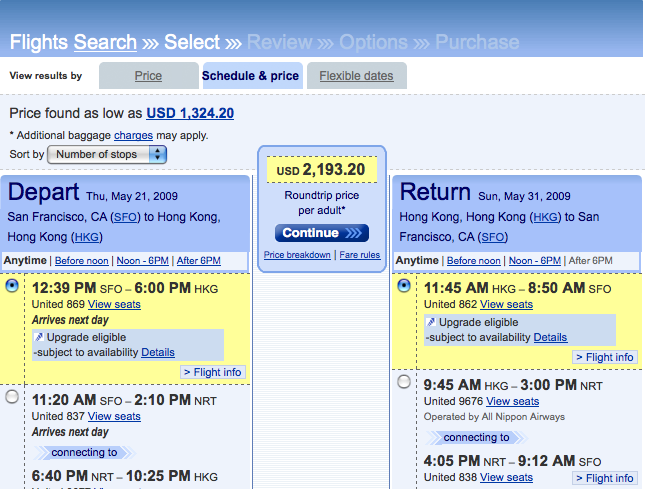
The cost to buy a round trip international ticket is: $2,193.20 when it is “Upgrade Eligible” compared to $1,324.20 for a discounted and un-upgradable international ticket. As of today, I would have to use 60,000 airline miles plus $2,193.20 to get a round trip business class ticket on UAL from North America (San Francisco) to South Asia (Hong Kong).
Beginning July 1, 2009, I would probably have to pay an additional $500 co-pay charge plus 50,000 for the same international round trip ticket. The Upgrade Award chart was not really clear on the exact co-pay charge but it did say it would cost me 50,000 miles for a round trip upgrade from North America to South Asia.
For the record, a Business Class international ticket for the exactly time and dates was $2,985.20. The total price of $2,193.20 + $500 and 50,000 miles is not much cheaper (if not more expensive since you need to earn your miles) than the regular $2,985.20 Business Class ticket. With the business class ticket, you probably can earn more bonus points on UAL.
In summary, I strongly urge everyone to use their airline miles upon accrual. Just like the US dollar, inflation is inevitable. Today’s miles won’t go as far tomorrow.
